
What Is SEO and Why Is It Important?
SEO, or Search Engine Optimization, is the process of improving your website so it can appear higher in search engine results, especially on Google. Good SEO helps people find your website when they search for information, products, or services related to what you offer.
A strong SEO strategy can bring more visibility, more visitors, and better chances of turning those visitors into customers. But getting good results from SEO is not just about using keywords. There are many small mistakes that can affect your website’s performance and rankings.
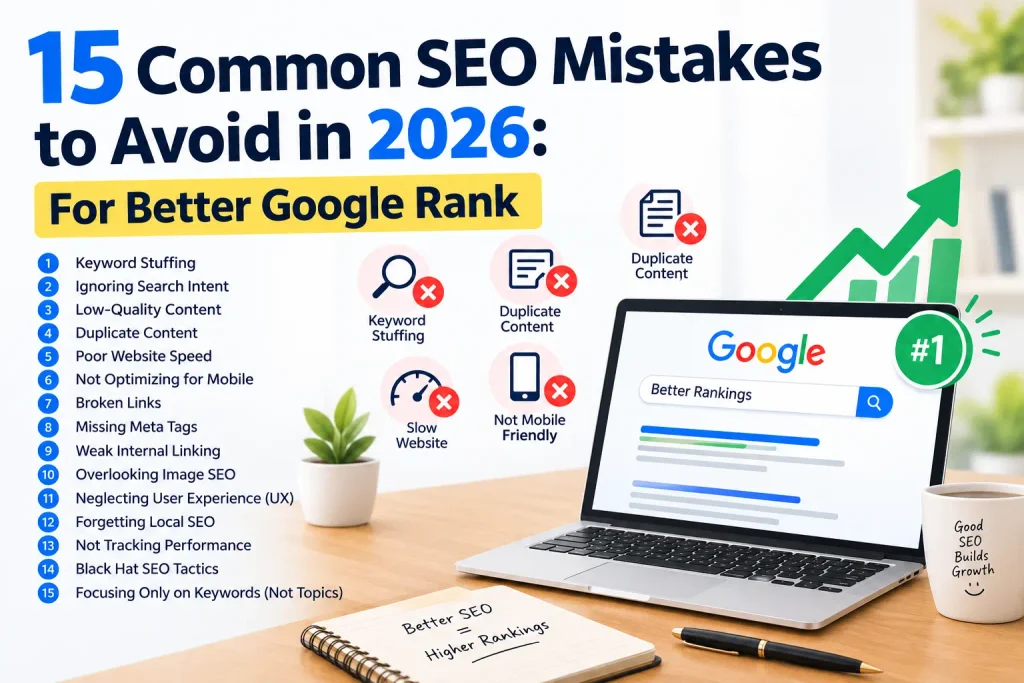
The 15 common SEO mistakes you should avoid in 2026 are listed below.
1.Keyword Stuffing Using the same keyword again and again won’t help your website rank higher. In fact, it can do the opposite.
Keyword stuffing means forcing a keyword into your content so many times that the writing starts to sound weird.
For example:
“Looking for the best digital marketing agency? Our digital marketing agency offers the best digital marketing services because we are the best digital marketing agency.”
Sounds unnatural, right?
Write for people first, Google second. Use your main keyword naturally, and focus on answering what the reader actually wants to know.
Simple rule: If a keyword feels forced, remove it. Good SEO should sound like a real person wrote it.
2.Ignoring Search Intent
People search on Google for a reason. They might want an answer, compare products, find a service, or learn how to do something.
If your content doesn’t match what they’re actually looking for, it may struggle to rank—even if your keywords are perfect.
The simple fix? Before writing, search your target keyword on Google. See what kind of content is already ranking and understand what users expect. Then create content that gives them exactly that.
Don’t just target the keyword. Target the reason behind the search.
3.Low-Quality Content
Writing content just to fill a page won’t help your website rank. If your content is too short, boring, outdated, or doesn’t give readers a useful answer, they’ll simply leave.
Google wants content that actually helps people.
So, don’t write just for SEO. Share useful information, keep it clear, add real examples, and answer the reader’s questions properly.
Simple rule: Give people something worth reading, not just something for Google to index.
4.Duplicate Content
Copying the same content from another page—or even using the same content across several pages on your own website—can confuse search engines and make it harder for the right page to rank.
Your content should have something original and useful to offer.
Don’t just copy what’s already out there. Add your own ideas, examples, experience, or better explanation.
Simple rule: Don’t copy. Add value.
5.Poor Website Speed
Nobody likes waiting for a slow website—not your visitors, and not Google.
If your pages take too long to load, people may leave before they even see your content. A slow website can also hurt the overall user experience.
The fix? Compress large images, remove unnecessary plugins, use a good hosting service, and keep your website lightweight.
Simple rule: Make your website fast, smooth, and easy to use.
6.Not Optimizing for Mobile
Most people now, use their phones to search Google, so your website needs to work well on mobile devices.
If your website looks messy, loads slowly, or is hard to use on a phone, visitors may leave quickly. This can also hurt your SEO and Google rankings.
Make sure your website has a mobile-friendly design, fast loading speed, easy navigation, and readable text on smaller screens.
Simple rule: If your website isn’t mobile-friendly, you’re missing both visitors and SEO opportunities.
7.Broken Links
Broken links are links that lead to a page that no longer exists or doesn’t work. They can frustrate visitors and make your website feel poorly maintained.
They can also create SEO problems by making it harder for search engines to crawl your site properly.
Check your website regularly and fix, replace, or remove broken links.
Simple rule: Keep your links working and your website easy to navigate.
8.Missing Meta Tags
Meta tags may not be visible on your webpage, but they still play an important role in SEO. Your title tag and meta description help Google understand what your page is about and can encourage people to click on your result.
If you skip them or leave them poorly written, you may miss a simple SEO opportunity.
Use a clear SEO title and write a short, relevant meta description for every important page.
Simple rule: Help Google to understand your page before asking it to rank.
9.Weak Internal Linking
Internal links connect one page of your website to another. They help visitors find more useful content and help Google crawl and understand your website better.
If you don’t use enough internal links, some important pages may get less visibility and authority.
Link related pages naturally using relevant anchor text. For example, if you’re talking about SEO keywords, link to your detailed guide on keyword research.
Simple rule: Connect your content. Help users explore and Google understand your site.
10.Overlooking Image SEO
Images can also help your SEO, but many websites completely ignore them.
Large, unoptimized images can slow down your website, while missing alt text makes it harder for Google to understand what an image is about.
Use descriptive alt text, compress your images, and choose clear, relevant file names. This can improve page speed, accessibility, and image SEO.
Simple rule: Don’t just optimize your content—optimize your images too.
11.Neglecting User Experience
SEO isn’t only about keywords and rankings. User experience (UX) matters too.
If your website is confusing, hard to navigate, slow, or filled with annoying pop-ups, visitors may leave quickly. That’s a bad experience for users and can hurt your SEO performance.
Keep your website simple, fast, mobile-friendly, and easy to navigate. Make it easy for visitors to find what they need.
Simple rule: Make your website easy for people, and SEO becomes easier too.
12.Forgetting Local SEO
If you run a local business, ignoring local SEO means missing out on people searching for your services nearby.
Make sure your Google Business Profile is complete and up to date. Keep your business name, address, phone number, working hours, and website details accurate across the web.
Also, encourage genuine customer reviews and use location-based keywords naturally in your content.
Simple rule: If you want local customers, make it easy for Google to find and understand your business
13.Not Tracking SEO Performance
Doing SEO without tracking results is like working hard without knowing whether your efforts are paying off.
You might be publishing blogs and updating your website, but are your rankings improving? Are people visiting your pages? Which keywords are bringing traffic? Without tracking, it’s hard to know what’s working and what needs improvement.
Use Google Search Console to monitor your keyword rankings, clicks, impressions, and search performance. You can also use Google Analytics to understand how visitors interact with your website.
Simple rule: Don’t just do SEO. Track it, learn from it, and improve it.
14.Using Black Hat SEO Tactics
Trying to trick Google with black hat SEO tactics might bring quick results, but it can seriously hurt your website in the long run.
Things like buying spammy backlinks, hiding keywords, creating fake pages, or using other manipulative SEO techniques can lead to ranking drops or even penalties.
Focus on white hat SEO instead—create useful content, build genuine backlinks, and follow Google’s guidelines.
Simple rule: Don’t try to cheat Google. Build a website that deserves to rank.
15.Focusing Only on Keywords, Not Topics
Keywords are important for SEO, but they’re not the whole story. If you focus only on adding keywords, your content can become repetitive and miss what readers actually want to know.
Instead, focus on the topic as a whole. Cover related questions, useful subtopics, and important information around your main keyword.
For example, don’t just write about “SEO tips.” Talk about keyword research, content quality, backlinks, technical SEO, user experience, and other relevant areas.
Simple rule: Don’t chase keywords. Cover the topic properly.
Conclusion: Building SEO That Lasts
Looking across all 15 mistakes, a clear pattern emerges: nearly every one comes down to the same root problem, optimizing for search engines instead of for people. Keyword stuffing, thin content, duplicate pages, and topic-blind writing all happen when the goal becomes “rank higher” rather than “help the reader.” The article’s repeated advice to write for people first and Google second is the thread that ties the whole list together.
The mistakes also fall into three broad groups. The first is content-related: keyword stuffing, ignoring search intent, low-quality writing, duplication, and focusing on keywords instead of topics. The second is technical: slow speed, poor mobile optimization, broken links, missing meta tags, and unoptimized images. The third is strategic: weak internal linking, neglected user experience, overlooked local SEO, no performance tracking, and black hat shortcuts. Strong SEO needs all three working together, since excellent content on a slow, broken site will still underperform.
It’s worth noting that many of these fixes are simple and low-cost. Compressing images, writing meta descriptions, repairing broken links, and setting up Google Search Console require more consistency than expertise. The bigger challenge is discipline: auditing regularly, tracking what works, and resisting tempting shortcuts that promise fast results but risk penalties.
The article’s closing “simple rules” capture the philosophy well: don’t copy, add value; don’t cheat, deserve to rank; don’t chase keywords, cover the topic. These aren’t just slogans. They reflect how modern search engines evaluate quality, rewarding helpful, original, and well-structured experiences.
For anyone working on their website in 2026, the takeaway is practical: start with an audit against this list, fix the quick technical wins first, then invest steadily in useful, intent-matched content. SEO is a long game, and results compound over time. Sites that consistently serve their visitors well, loading fast, working on every device, and answering real questions, are the ones best positioned to earn lasting visibility and trust, both with readers and with Google.